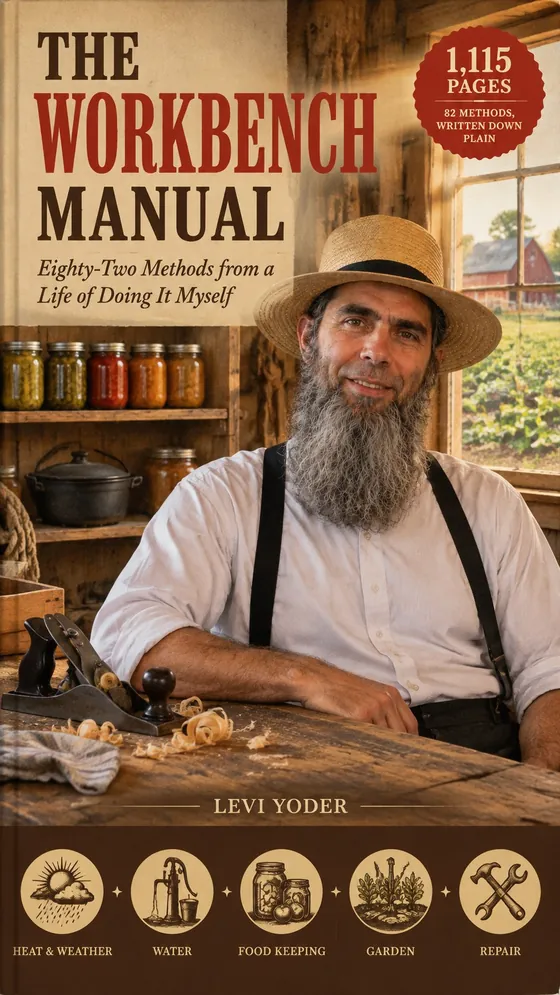
Levi Yoder · The Workbench Manual
A lot of what your house needs costs nothing. Somebody just has to tell you which jobs.
Eighty-two chapters from the bench inside my barn door, on heat, water, power, food, pests and repair. Every one says what I got wrong.
Manual $9.99 · 30-day money-back guarantee

Free
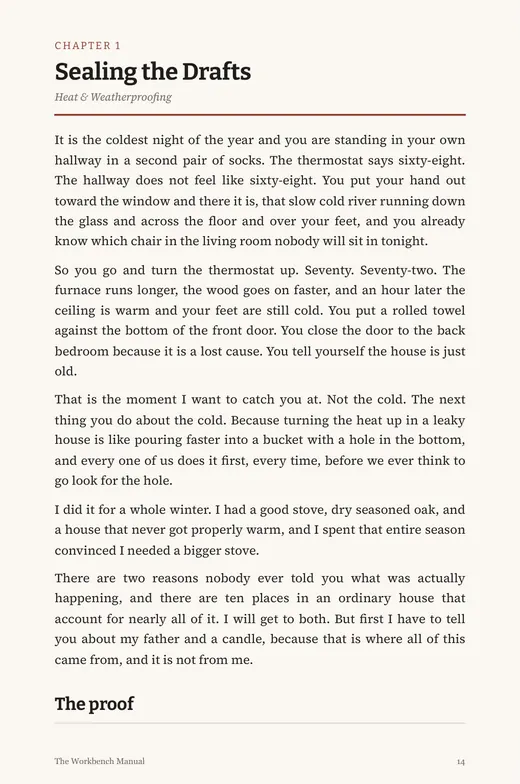
Get the free 30-Day Independence Challenge and chapter one
Put your email in the box and two things open on the very next page, both free: the whole 30-Day Independence Challenge, and Chapter 1, Sealing the Drafts. Thirty small jobs around the house, one a day, one page each, with a box to tick. There is nothing to install and no card to enter.
The Workbench Manual
The 30-Day Challenge is free. 30-day money-back guarantee.
Your house runs on numbers nobody ever checks.
These are them. Not my numbers, the government's: what an ordinary American household actually spends in a year, from the Bureau of Labor Statistics and the Energy Information Administration.
Hold a candle to them.
Hold a candle near a leaky window frame and the flame leans where the air is moving. Chapter one, the free one, goes back to my father and a candle. Before I did the work in it, my woodpile ran out in the middle of February. After, the same size pile carries me into the first week of April, and nothing I bought that winter cost more than a tube of caulk. Keep a flame well clear of curtains.
Beside each line is the part of the book that goes after it. I am not going to tell you what you will save, because I do not know your house. I will tell you where the money goes.
-
Heating and coolingEIA / BLS household averages$2,000 to $2,500
Sealing, insulating, and heating the room instead of the houseSections 1 and 2 · 18 chapters
-
Water and sewerBLS, household utilities$600 to $800
The leak that makes no noise, and catching rainSection 3 · 6 chapters
-
Water heatingEIA, residential end use$400 to $550
Scale, and the annual flush nobody doesChapter 22
-
Upkeep and small repairsBLS, household maintenance$1,000 to $2,000
The walk in the rain, and the gutters above itSection 10 · 8 chapters
-
Cleaning and household suppliesBLS, housekeeping supplies$250 to $400
Five jobs, six substancesSections 8 and 9 · 12 chapters
Sources: US Bureau of Labor Statistics, Consumer Expenditure Survey · US Energy Information Administration, Residential Energy Consumption Survey. What you keep depends on your house, your climate, your prices and how much of it you actually do. The book prints no savings figure of its own and says why.
Eleven sections, aimed at every line on that page.
$9.99. Once. The bills come back every year.
Eleven sections, 82 chapters, 1115 pages.
Tap a section to see its chapters.
01Heat & Weatherproofing8 chapters
- Sealing the Drafts
- The Attic Blanket
- Windows Without Replacing Them
- Night Insulation
- Heat Mass, and Where to Put It
- Where a Stove Goes, and Why
- Floors, Crawlspaces and the Band Joist
- Heating the Room, Not the House
02Cooling10 chapters
- The Night Flush
- The Attic Is the Oven
- Shading the Glass, from the Outside
- Evaporative Cooling, and Where It Actually Works
- Moving Air Over Skin
- The One Cool Room
- The Heat You Make Indoors
- The Roof, and What Colour It Is
- Making an Air Conditioner Work Half as Hard
- The Cool That Is Already There
03Water6 chapters
- Where Your Water Comes From
- Frozen Pipes, and the Morning After
- Catching Rain
- Hard Water and What It Eats
- The Leaks You Cannot Hear
- Water When the Power Is Out
04Off-Grid Power6 chapters
- What You Actually Use
- Small Solar That Works
- Batteries
- Inverters
- The Copper, the Fuse, and What Starts Fires
- What You Actually Have to Keep Running
05Food Preservation8 chapters
- The Root Cellar
- Cold Without a Refrigerator
- Drying
- Salt, Sugar and Smoke
- Water Bath Canning
- Pressure Canning
- Fermentation
- Flour, Rice, Beans and What Gets Into Them
06Garden8 chapters
- Soil Is the Whole Thing
- Compost
- Watering
- Mulch
- Starting From Seed
- Spacing and Succession
- Borrowing Weeks at Both Ends
- Saving Seed
07Pest Control12 chapters
- Identify Before You Act
- The Hole Is the Pest
- Rats and Mice
- Mosquitoes
- Ants
- Cockroaches
- Wasps and Hornets
- Ticks, and the Shape of a Yard
- Snakes
- Slugs, Snails and the Ones That Work at Night
- What Gets Into Stored Things
- Diatomaceous Earth, Borax, and What People Reach For
08Household Substances8 chapters
- The Cupboard Under the Sink
- Vinegar
- Bicarbonate, Washing Soda and the Caustic End
- Bleach
- Soap and Detergent
- Solvents
- Oils, Waxes and Finishes
- Labels, Storage and Getting Rid of It
09Cleaning4 chapters
- The Order of Operations
- The Kitchen
- Bathrooms, Damp and Mould
- Floors
10Structure & Repair8 chapters
- Water Is What Destroys Buildings
- Gutters, Downpipes and Where the Water Goes
- The Three Kinds of Damp
- Ventilation, and the Problem We Made
- Rust
- Rot
- Fixings
- Fix It, Watch It, or Telephone Somebody
11Land4 chapters
- Where the Water Goes
- Boundaries, Trees and Neighbours
- Looking at Land Before You Buy It
- The Things You Touch Every Day
Every chapter is built the same way.
- What the problem actually is.
- What almost everybody does instead, and why it does not work.
- What I do, and what it cost.
- Where the safety line is.
- What I got wrong.
- And what the method will not fix, stated plainly.
A book that only ever says "this works" is not one you can trust the second time.
“Find out what is actually happening.
Then do the free thing first.”

I did not write this because the old ways are charming. I wrote it because most of what goes wrong with a house is a problem nobody has identified, being treated by somebody who was sold a solution for a different one.
Almost every chapter in here ends up in the same place. The identification is free. The thing with the best evidence behind it is usually a walk, a habit, a spade or an afternoon. And the thing with the advertising budget is third on the list.
The people I made this for are not beginners. You have a house, or a place, and you have been quietly working around something for years. This is the book I wish somebody had handed me before I painted over the stain.
Read it once through. Then go to work.
What gets passed around
The deal this book makes with you.
Where it has been properly tested and failed, I say so, including the ones I used for years.
I tell you to pay somebody independent instead, and why that is the cheapest money in the book.
There are about ten places I refuse to print a figure. I say so at the point, and name the tested source instead.
I tell you to stop and telephone somebody, and which trade to call.
The 30-Day Independence Challenge
The manual is the reference. This is the month.
Thirty small jobs, one a day, one page each, with a box to tick and room to write down what you found. Week one is heat and power. Week two is water. Week three is pests. Week four is the repairs that keep paying after you stop paying attention.
Day one is twenty minutes and a wet hand, and by the end of it you have a map of every place your house loses its heat.
Most days cost nothing. Nothing in it is over about twenty-five dollars, and there is not one job that needs a contractor, a permit or a tool you probably do not already own.
44 pages · one job a day · PDF · free
Read it for a month. If it is not for you, I do not want your money.
Read it for thirty days. If it is not what you hoped, write to me at [email protected] and I will refund every cent, no questions. Pay once and it is yours to keep, on your phone, your tablet, or printed at the kitchen table. No subscription. Nothing else to buy.
It is a working manual, not a doorstop. 82 chapters, each one a problem you can start on in the morning.
30-day refund · emailed instantly · PDF · yours forever
Visa · Mastercard · PayPal · Apple Pay · Delivered by email the moment you buy
About your place
Do I need to own my house for this to be worth it?
Some of it needs permission and some of it is your landlord's property, and the book says so plainly in the closing rather than pretending otherwise. What still works if you rent: sealing drafts, the food storage, the pest exclusion in the parts you occupy, all of the substances and cleaning sections, and the whole garden section if you have any ground. For the rest, the book tells you how to put it to a landlord in writing.
Do I need to be handy?
Mostly a flashlight, a spade, an awl and an afternoon. A surprising share of the book is walking around your own property at the right moment and knowing what you are looking at. Where a job needs an electrician, a gas fitter, a structural engineer or a chimney sweep, the chapter says so and says why.
Will this work where I live?
The mechanisms are physics and they do not care where you are. Where something is genuinely regional, such as evaporative cooling, night-flush ventilation or what is legal about rainwater and boundaries, the book says so and tells you to check your own conditions rather than assuming mine.
About the book
Food preservation and pest control. Is that safe to follow at home?
Those are the strictest sections in the book, and they are strict in an unusual way: they refuse to print processing times, pressures, cure percentages and doses. Every actual process routes to a currently tested source such as the National Center for Home Food Preservation or a state extension service, and the book explains at each point why it will not give you a number of its own.
Is there medical or legal advice in it?
None, deliberately. Several subjects touch on both. Every one of them routes to a doctor, to published public health guidance, or to a lawyer. The boundaries chapter states outright that it is not legal advice and that property law varies by jurisdiction.
What do I get, and is it a subscription?
One book: a 1115-page PDF, emailed the moment you buy. It reads on a phone, a tablet or a computer, and it is laid out to print at home. You pay once. Nothing renews.
Most of it was free. Somebody just had to tell you which part.
Eighty-two chapters on the house, the water, the power, the food, the ground and the small ordinary things you put your hand on every day. 1115 pages. One honest book. $9.99, once.
Not sure yet? Read chapter one free, or send this page to whoever helps you with the house.
30-day refund · emailed instantly · PDF